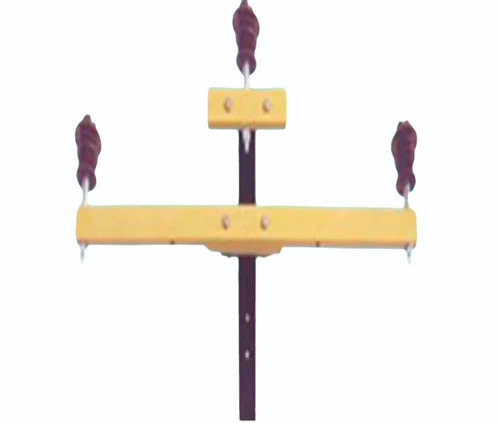
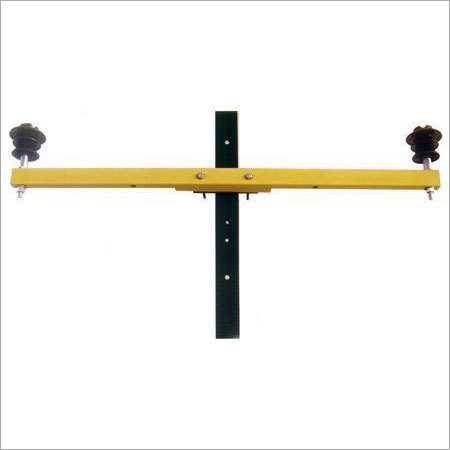
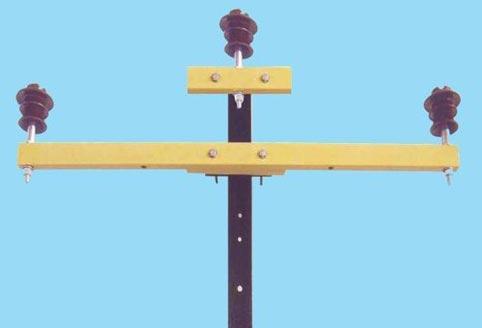
33 kV FRP Cross Arm About
Product details
| Clamping holes | 18 mm dia spaced at 230 mm at center |
| Material | FRP |
| Mechanical strength | Passes REC Specification In X and Y direction at 400 and 135 Kgs |
| Length | 1605 mm (as per REC specifications) |
| Holes for pin insulators | 22 mm dia spaced at 1525 mm c/c at center |
| FRP Section used | 55 x 110 mm (box section) |
Specification
| FRP Section used | 55 x 110 mm (box section) |
| Length | 280 mm (as per REC specifications) |
| Clamping holes | 18 mm dia spaced at 200 mm at center |
| Holes for pin insulators | 26 mm at center |
Exceptional Strength and Rigid DesignEngineered from premium FRP material, this cross arm delivers remarkable mechanical strength and rigidity. Its corrosion-resistant, coated surface ensures extended service life in demanding industrial environments. The rectangular shape enhances stability, making it an ideal choice for power distribution networks that require durability and reliability.
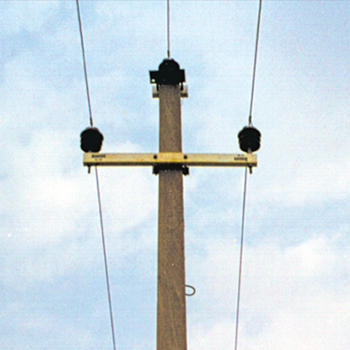
Industrial Applications and VersatilityThe 33 kV FRP Cross Arm is specifically crafted for industrial settings, supporting electrical conductors securely in overhead systems. Its yellow and black visibility aids in quick identification and safety compliance. Trusted by professionals across various industries, this cross arm supports seamless integration into new and existing electrical infrastructure.
FAQ's of 33 kV FRP Cross Arm:
Q: How is the 33 kV FRP Cross Arm installed in industrial overhead distribution systems?
A: The 33 kV FRP Cross Arm is mounted onto support poles using industry-standard brackets and fasteners. Proper alignment and secure fixation are essential for optimal performance and safety, ensuring reliable support for electrical conductors.
Q: What are the main benefits of using FRP material for this cross arm?
A: FRP (Fiber Reinforced Polymer) provides excellent strength-to-weight ratio, rigidity, and high resistance to corrosion and electrical conductivity. This results in longer service life, reduced maintenance, and enhanced operational safety in harsh industrial environments.
Q: When should the 33 kV FRP Cross Arm be considered over traditional materials?
A: It should be chosen in environments prone to corrosion, extreme weather, or where electrical insulation is critical. FRP cross arms are ideal when reliability and reduced maintenance are priorities.
Q: Where is this cross arm commonly supplied and installed?
A: As an exporter, manufacturer, and supplier in India, these cross arms are delivered to industrial plants, substations, and power distribution sites nationwide. They are also suitable for export to international markets requiring similar specifications.
Q: What is the typical manufacturing process for the FRP Cross Arm?
A: The cross arm is produced through a pultrusion process, where continuous FRP fibers are infused with resin and shaped into rigid rectangular forms. The final product is surface-coated to enhance durability and environmental resistance.
Q: How does the surface treatment improve the cross arm's longevity?
A: The coated surface treatment protects the FRP material against UV exposure, moisture, and chemical attacks, thus significantly extending its operational life and maintaining its structural integrity.




 Send Inquiry



 Send Inquiry



 Send Inquiry
 Send SMS
 Call Me Free


 English
 Spanish
 French
 German
 Italian
 Chinese (Simplified)
 Japanese
 Korean
 Arabic
 Portuguese